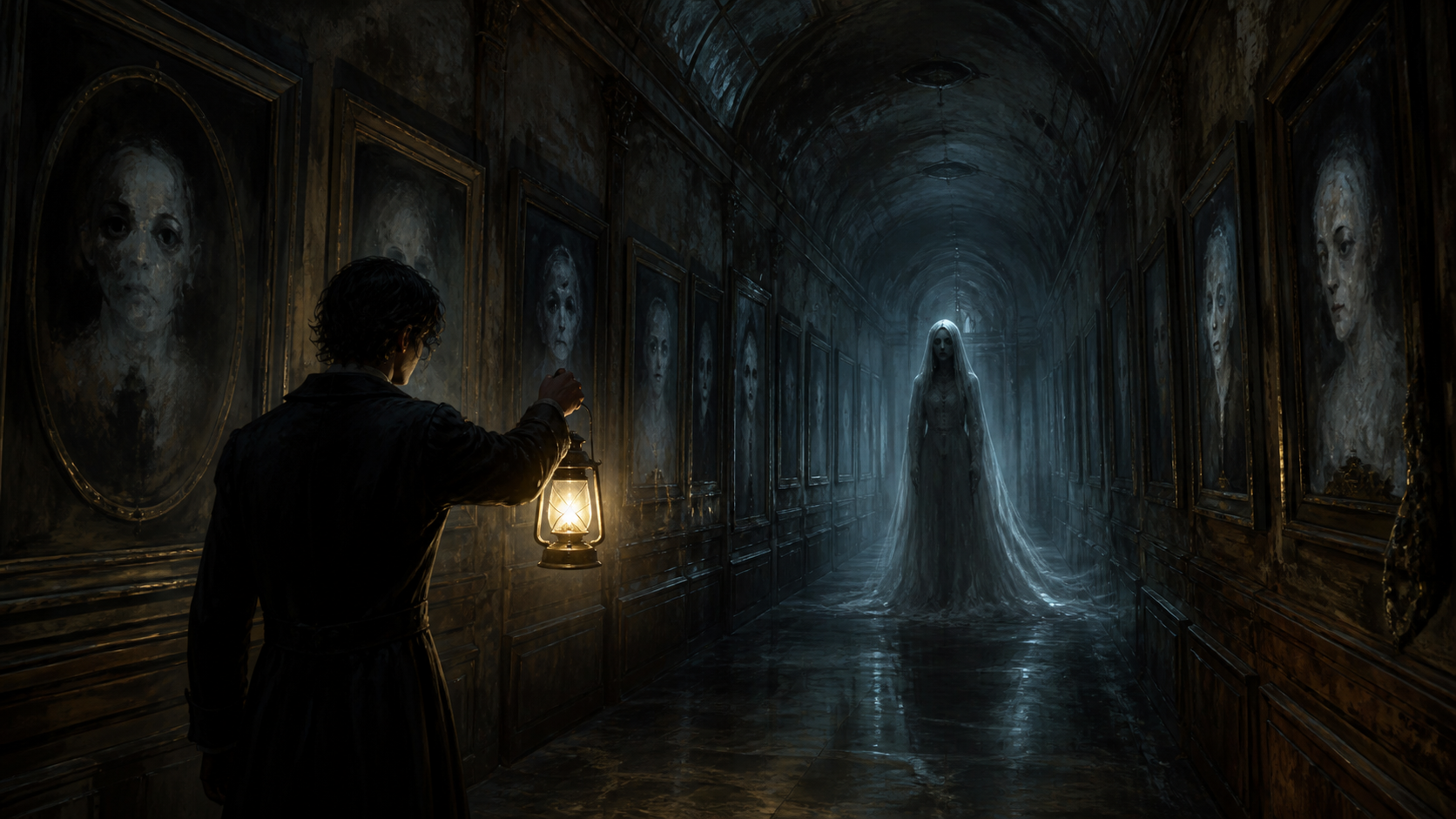
By the third week in November, the house had learned their names.
Not spoken them exactly. That would have implied intent, and intent was too human a word for what lived in the old terrace on Mercer Street. But it had learned the sounds of them. The way Lena muttered “Christ” when the immersion heater coughed. The soft, impatient laugh Tom made when he could not find his keys. The child’s half-formed whine that belonged to Daisy when she was tired and wanted to be carried.
And after midnight, when the street outside had gone black and slick with rain, the house would whisper those sounds back.
At first Lena thought it was the neighbours. The terrace walls were thin and the district was dense with old Victorian conversions and tired plumbing, all of it breathing through the night. She lay awake the first time it happened with one hand on Tom’s back, listening to the low, papery murmur that came from somewhere above the landing. It sounded almost like speech, but not quite. A voice reduced to breath.
“Do you hear that?” she whispered.
Tom, already half-asleep, grunted. “The pipes.”
“It’s not the pipes.”
He opened one eye, annoyed. “Everything in this house is the pipes, according to you.”
Lena went rigid, listening. The sound had stopped. In the silence that followed, the old floorboards gave a small, settling creak, as if someone had stepped away from the top of the stairs.
She got out of bed and opened the bedroom door. The landing was dim and empty. The child gate at the top of the stairs stood shut. Daisy slept in her room at the back, one small hand flung over her pillow. The air smelled faintly of damp plaster and the cheap lavender spray Lena used in a futile effort to make the place feel less rented, less temporary.
“Nothing there,” Tom murmured from the bed.
Lena stood in the doorway for a moment longer. The house had a peculiar habit of holding its breath. Even without the whispering, there was a pressure in it, as though the rooms were listening.
She shut the door and went back to bed.
By morning she had almost convinced herself she had dreamed it.
Almost.
The house on Mercer Street had belonged to an elderly woman called Mrs Wren, dead for six months before Lena and Tom moved in. The letting agent described the place as “characterful”, which meant damp in the downstairs front room, a temperamental boiler and wallpaper the colour of old tea. It had two bedrooms, a narrow kitchen extension and a small back garden overrun with ivy that climbed the brickwork like fingers. Lena had grown up in a tower block in Salford and Tom in rented flats above takeaway shops, so to them the terrace represented the sort of modest permanence they had never quite managed before. It was not theirs, not really, but it could become theirs. That was enough.
They moved in because Daisy needed a room of her own and because Lena had been offered more hours at the hospice, meaning more money, meaning perhaps a future where everything was not paid for in instalments and apologies.
At first the house seemed merely old and unhappy. It had the draughts of old houses, the moody radiators, the way cupboards opened by themselves in the night. Daisy, three years old and fearless in the manner of children who have not yet understood the concept of homes becoming unsafe, loved it immediately.
“There’s a lady in the kitchen,” she announced on their second afternoon, standing with a spoonful of yoghurt hanging from her mouth.
Lena laughed. “Is there?”
Daisy nodded with grave certainty. “She says not to go upstairs when it’s dark.”
Tom looked up from assembling a bookcase. “Well, that’s good advice in any house.”
“Daddy,” Daisy said, exasperated, “she’s old.”
Lena and Tom exchanged a glance. Children said odd things. Children made invisible companions out of shadows and strangers out of patterns. They smiled, made a joke of it and moved on.
But the house did not move on.
The whispering began to recur after midnight, always faint, always just on the edge of intelligibility. Sometimes Lena heard it from the landing. Sometimes from the stairwell. Once, while she was in the bathroom at 12.17 in the morning, she heard her own voice murmuring from the airing cupboard behind the sink.
Lena froze, one hand on the basin.
The whisper repeated. Not words exactly, but her voice, the tone flattened into something tired and intimate. A private sound stolen and returned.
She yanked open the cupboard. Towels, detergent, the hot water cylinder humming behind a metal panel. Nothing else.
When she told Tom, he gave her a long, doubtful look.
“You’re stressed,” he said. “You’ve got the hospice, Daisy’s been teething, and this place is freezing.”
“I know what I heard.”
“I’m not saying you didn’t. I’m saying old houses make noises. People live in them and then they die and the house keeps creaking for a while.”
“That is not how houses work.”
“It is how houses work when you’re skint.”
She wanted to argue, but Daisy came in at that moment dragging her blanket, and the moment passed.
Then came the stains.
First on the wallpaper in the upstairs hall, a pale brown bloom just beneath the picture rail. Then, two days later, on the ceiling of Daisy’s room, a narrow wet line that darkened through the paint and smelled faintly metallic. Tom climbed up with a torch and declared it a leak from next door.
“Next door’s empty,” Lena said.
“Then upstairs.”
“There is no upstairs.”
“Exactly,” he said, not meeting her eyes.
The council sent a man round who scratched at the stain, sniffed it and pronounced it “old water ingress”. He advised repainting and possibly re-roofing the extension. Lena nodded and said thank you while Daisy, clutching her toy rabbit, stared at the ceiling and whispered, “She’s crying.”
“What did you say?” Lena asked.
Daisy pointed. “The lady.”
There was no stain left by the following morning, though the smell lingered, sweet and wrong, like rust mixed with cut flowers.
Lena was beginning to feel watched. Not in the abstract way people say when they are anxious, but in the physical sense of being measured by attention from a space too patient to reveal itself. She began to hate going upstairs after dark. She hurried through the hallway and kept the bathroom door open. If Daisy cried in the night, she ran before she had time to think.
Tom, meanwhile, retreated into practicalities. He was an electrician, freelance, and spent his days in lofts, under sinks, behind fuse boxes. He believed in faults and fixes. His patience with Lena’s fear was limited and thinning.
“You’re making it worse,” he said one night after she’d confessed she had heard whispering from the nursery wall. “If you keep waiting for something, you’ll hear it.”
She stared at him across the kitchen table. Their mugs of tea had gone cold. Outside, rain ticked at the back door.
“I’m not imagining Daisy talking to herself.”
“Kids do that.”
“She says the lady is warning her.”
“Warning her about what?”
Lena swallowed. “Upstairs.”
Tom leaned back, rubbing his eyes. “Lena.”
“What?”
“Don’t start pulling the place apart because a three-year-old has a vivid imagination.”
The look she gave him was so hard that he glanced away.
That night, after Daisy had fallen asleep with her rabbit under her chin, Lena woke at 12.08 to a whisper from the bottom of the stairs.
She lay still, every muscle clenched. Tom was breathing beside her, deep and steady. The whisper came again, barely audible, a thread drawn through darkness.
Not words.
Her name.
Lena rose without switching on the light. The door opened with a dry scrape that made her flinch. The landing was black. The whisper came from below, from the stairwell where the banister curved into shadow.
She went to the top step and looked down.
There was no figure. Only the stairs, pale in the moonlight from the front window, and the darker mouth of the hallway below. Then, from the space by the front door, came a sound like wet breathing. A patient, labouring inhale.
She backed away.
At the same moment, Daisy began to cry.
Lena flew into the nursery. The room was cold enough to sting. Daisy was standing in her cot, tears on her face, staring at the wall beside the window.
“Don’t let her take me,” she sobbed.
Lena snatched her up. “Who, love?”
Daisy clung to her and shook. “The whisper lady.”
Tom stumbled in behind them, blinking and pale. “What’s happening?”
“Something’s here,” Lena said.
For once he did not argue. He looked at Daisy, at the wall, then over Lena’s shoulder to the open door. Something in his face changed, a narrowing, a recognition of fear that was not his own.
The whispering had stopped.
They spent the rest of the night on the sofa with the lights on and Daisy wedged between them. At dawn Tom went through the entire house with a torch and a screwdriver, checking sockets, panels, vents, the loft hatch. He found nothing except the usual damp and the roof lining torn loose by birds.
But in the far corner of the loft, behind a stack of rotten suitcases, he discovered a small painted door set into the plaster.
It was no bigger than a serving hatch, its white paint cracked and yellowed with age. There had once been a brass handle. It had been removed long ago, leaving two rusted screw holes.
Tom stared at it, torch beam trembling.
Lena climbed the ladder behind him. “What is that?”
“I’ve no idea.”
She touched the wood. It was cold and dry, unlike the damp plaster around it.
“Is there space behind it?”
Tom prised one of the suitcases away and pressed an ear to the panel. He pulled back almost at once.
“Did you hear that?” he said.
Lena had. From the other side, a barely audible whispering, as if a whole congregation were speaking through their hands.
Tom swallowed. “It’s not an air gap.”
“What then?”
He did not answer. He was already reaching for the screwdriver.
The door opened inward with a scraping sigh, and a smell rushed out so sudden and foul that Lena staggered back. Old urine. Wet plaster. Something sour beneath it, the odour of a room long closed over a dying thing.
Inside was a cavity the size of a cupboard. Not empty. At the back, set into the brickwork, was a narrow shelf. On it lay a woman’s wedding ring, a child’s hair ribbon blackened with damp, and a stack of folded papers tied with fraying string.
Tom said nothing. He took the papers down and, with visible reluctance, untied them.
The top sheet was a letter written in a fine, sloping hand. The paper had browned around the edges. The date was 1978.
My dear, if you are reading this then she has done what she promised she would do and hidden the key again.
Lena felt her stomach tighten.
Tom read on. His face grew blank.
The letter was from a woman named Evelyn Wren to someone called Samuel. She wrote of her husband’s “temper”, of the child’s illness, of whispers in the walls that began after the midwife’s visit. She begged Samuel not to leave her alone in the house again. There were references to the “small room” and to “Mary upstairs”, though no Mary appeared elsewhere in the pages.
The letters grew more frantic as the stack continued. One spoke of the child waking with handprints on her throat. Another described waking to find the nursery door nailed shut from the outside. A third ended mid-sentence, as if the writer had been interrupted. The last line, repeated twice in a feverish scrawl, read: She comes when the house is quiet enough to hear.
Tom dropped the papers.
Lena looked up at him. “Who is she?”
He did not answer. He had gone as white as the plaster dust on his hands.
Then, from below them, from the stairwell leading to the landing, came a whisper.
Not from the walls this time. From the hallway.
Lena.
The voice was a woman’s, dry and intimate and very near.
Lena backed into Tom so hard he nearly lost his footing.
The whisper came again, louder. Not calling, exactly. Repeating.
Lena.
Tom grabbed the torch and swung it towards the loft ladder.
There, in the opening below, stood a woman in a dark coat with wet hair plastered to her face. She was so still that for one stunned second Lena thought it was a neighbour. Then the torch beam found her features, or what was left of them.
One eye was milky and filmed. The other had sunk back into the skull. Her mouth was open in a black oval, as if she had forgotten how to close it. Her throat was split from jaw to collarbone, not bleeding, but ragged and dark with old rot.
Daisy began screaming.
The woman lifted one hand and placed a finger to her torn lips.
Hush.
Tom lunged for the ladder. Whether he meant to strike her, push past or simply flee, Lena never knew, because at that instant the woman was no longer at the hatch. She was beside the nursery door at the far end of the landing, moving without crossing the space between.
Tom stumbled, hit the banister and went down hard on one knee.
The whispering in the walls surged all at once, a chorus of indistinct voices pressing from every room. The lights flickered. Daisy’s screaming cut to a choking gasp.
Lena ran. She reached the nursery just as the door slammed shut behind her with enough force to rattle the frame.
Inside, the room was dark except for the grey wash of morning at the window. Daisy was on the floor beside her cot, pointing.
The woman stood in the corner by the wardrobe.
She was not quite solid. The edges of her coat blurred into the wallpaper. Her head tilted with animal curiosity. Her mouth moved though no sound emerged, and then the whispering came, not from her but from the walls around Lena, all at once, many voices braided together.
She kept me here.
The statement landed with such force that Lena felt it physically, like cold water down the spine.
The woman raised one hand and pointed not at Daisy but at the floorboards beneath the cot.
Lena looked down.
A seam in the boards. Freshly prised. Beneath it, a black gap.
Tom hammered at the nursery door from the hall. “Lena! Open it!”
The whispering swelled.
She dragged the cot aside and tore up the loose board. There was a cavity beneath, roughly dug into the joists. Something glinted in the dark. She reached in and her fingers closed on a child’s shoe, tiny and brittle with age.
Another object lay beside it. A lock of hair tied with thread.
Then, deeper in the hollow, her hand touched bone.
Lena recoiled so violently she struck the wardrobe. The door opened a fraction under the blow. Inside, hanging from a nail, was the missing brass handle from the loft door, threaded on a string with a key.
Tom burst in at last, wrenching the door wide. He took in the broken floor, the shoe in Lena’s hand, the expression on her face, and for the first time in their married life, he looked truly afraid of the truth.
“Call the police,” Lena said, and heard her own voice rise thin and raw. “Call them now.”
He did.
The officers arrived by nine. Then a detective, then a preservation man from the council, then a pathologist who would not meet anyone’s eyes. The house was emptied, the floorboards lifted, the cavity opened properly. They found the remains of a child, no more than four years old, wrapped in oilcloth and hidden there for decades. They found fragments of a woman’s jaw in the wall behind the loft door. They found the truth, or enough of it: that the previous owner, Arthur Wren, had locked his wife and daughter in the house after the child fell ill, then claimed they had fled to relatives in Leeds. Evelyn had been beaten, kept, and finally killed. The child had died first or last, the reports were not certain.
Arthur Wren had lived long enough to sell the house and die in a care home, where he told nurses that his daughter spoke to him at night.
The official language was kinder than the reality.
Lena and Tom were told they had been very unlucky. The police thanked them for their cooperation. The council offered temporary accommodation. A social worker asked whether Daisy had been harmed. The question was gentle, but it made Lena feel sick.
No one could explain the whispering. The pathologist did not comment on the voices in the walls. The files did not include a section for grief that had nowhere to go.
The following night, in the hotel room on the ring road where they had been moved, Lena woke at 12.13 to a familiar sound.
A whisper.
Not in the walls here. Too thin for that. It came from the wardrobe, from the dark gap beneath the hanging shirts.
Tom was already awake. He sat up slowly, eyes fixed on the wardrobe door.
Daisy slept between them, one small fist curled around Lena’s sleeve.
The whisper came again.
Lena.
She should have been relieved the house was behind them. Instead, a terrible certainty took hold of her. The thing in Mercer Street had not stayed there because it was tied to the building. It had stayed because it had been made there, nourished there, trapped there with its dead, and now it knew the shape of her fear.
It had followed.
Tom reached for the lamp. Lena caught his wrist.
“No,” she said.
The whisper came a third time, sounding pleased now, almost amused. Then another voice, faint and childlike, joined it.
Mum.
Daisy stirred.
Lena’s hand tightened on Tom’s wrist until he winced. Together they listened as the wardrobe door gave a tiny, deliberate creak from within.
Then came a scratch, soft as a fingernail dragged across wood.
Tom reached for the hotel phone. His face had gone grey in the dim light.
“What are you doing?” Lena hissed.
“Calling reception.”
“Don’t let it hear you.”
“It already has.”
The scratching stopped.
Something shifted inside the wardrobe. A small, careful movement, as if clothes had been brushed aside by a hand that remembered fingers.
Lena looked at Daisy’s sleeping face and made her choice.
She slid out of bed and crossed the room barefoot. Tom grabbed her arm, but she pulled free and opened the wardrobe herself.
Only clothes. Suits, dresses, the ugly floral carpet of a standard family hotel wardrobe. No hidden space. No woman. No smell of rot.
Then, from behind the shirts, a whisper that was unmistakably hers.
There you are.
Lena screamed and slammed the wardrobe shut.
Tom was already at the phone. Daisy woke howling. A man from reception arrived with a torch and a keycard and a face full of irritation that turned, as soon as he heard what they thought they had heard, into reluctant concern. Security came. So did the police, who searched the room, the corridor, the adjoining bathrooms. Nothing was found.
But in the morning, when Lena opened her suitcase to pack, she found something folded in the lining pocket she was certain had been empty.
A strip of child’s ribbon, blackened with damp.
At the end of it was tied the brass key from the house in Mercer Street.
They never went back to the street. The council demolished the terrace after the coroner’s report, or most of it. The newspapers ran a brief piece about “a disturbing historical discovery”. Neighbours recalled nothing unusual, which was either true or a mercy.
Lena left her job at the hospice. Tom stopped taking work that required overnight call-outs. They rented a flat near the river where every room had a lock that worked and no one had died in the walls, at least not that they knew of.
Daisy stopped speaking about the lady after a while, but not before asking, one wet afternoon as Lena buttoned her coat, “Did she get out?”
Lena crouched in front of her. “Who, love?”
“The whisper lady.”
Lena had no answer that would comfort either of them.
Because sometimes, when the flat was quiet and the heating clicked in the pipes, she could still hear it.
Not from the walls now, but from the places silence had weight. Behind the fridge. Under the bed. Inside the wardrobe when the door was nearly shut.
A breath. A murmur.
Her name.
And sometimes, worse than that, another voice, small and far away, trying to answer.
Mum.

Ghost Stories