By the time the bells in Brighton had begun their evening toll, the sea was already black.
Tomás Vale stood in the doorway of his shop and watched the last of the promenade crowds drift away with their shopping bags and cheap umbrellas. The arcade lights across the road had switched on in a wavering line of neon. A gull screamed above the pier, and the wind off the Channel carried the stale tang of salt, chip fat and rain from somewhere inland.
He should have gone home an hour ago.
Instead he was still inside Vale Antiques and Curios, hand on the till drawer, staring at the small brown envelope propped against the counter. It had arrived that afternoon, delivered by a local courier with a bored expression and rain on his shoulders. No return address. Just his name, written in a cramped, careful hand.
For a long time, Tomás had thought it might be a bill, or another appeal from a creditor, or some idiot trying to sell him family silver. But the envelope had felt odd when he picked it up. Not heavy. Not exactly. Dense, somehow, as if it contained something that was not paper.
He tore it open at last.
Inside was a single key on a ring of tarnished brass, and a note folded into quarters. He opened the note and read it once, then twice, because the words did not settle properly in his mind.
You have something that was not meant to come home. Bring the key to room 417, Hotel Neptune, on the seafront. Midnight. Do not come alone.
There was no signature.
Tomás looked down at the key. The brass ring was stamped with a number almost rubbed away by time: 417. He set it on the counter and rubbed his face with both hands.
“Oi, are we closing or what?”
The voice came from the back room.
Leonie was standing in the doorway with her cardigan buttoned the wrong way, one sleeve shoved up over her elbow. She was thirty-three, tall, dark-skinned, and tired in the way only people who worked two jobs and slept badly could be tired. By day she ran the framing workshop behind the shop. By evening she catalogued stock and kept Tomás from answering emails rudely.
“Sorry,” he said.
She came forward, noticed his face, and frowned. “What’s happened?”
He held out the note.
She read it, then the key. “It’s some sort of joke?”
“No one jokes like this.”
“You’d be surprised,” she said, but less confidently than before. “Who’s room 417?”
“The Neptune. Seafront hotel.”
“Do you even know anyone there?”
“No.”
“Then don’t go.”
He let out a short laugh with no humour in it. “I wasn’t planning to.”
But his eyes had already gone back to the key.
Leonie followed his gaze and swore softly. “Tom. Tell me you’re not thinking of it.”
“It’s probably nothing.”
“A thing that says do not come alone is never nothing.”
He slid the note back into the envelope, though the paper felt suddenly damp in his fingers. “Maybe I should just call and ask.”
“Who?”
“Hotel reception.”
“It’s after six. And if someone’s playing a game, you’re not going to outwit them by ringing a desk bell.”
Tomás turned the key over. It was old enough to have a museum shine, but the teeth were clean. Used recently, or polished recently. He had an odd sense that he ought to recognise it, and that the recognition would be unwelcome.
Leonie watched him. “What is it?”
“I don’t know.”
“No,” she said. “What is it doing to you?”
He almost told her to go home, that she looked too sharp-eyed for this hour, too near the truth. But her expression had changed. She was no longer teasing him. She was looking at him as if he had gone very still in a dangerous room.
“It’s nothing,” he said, too quickly.
But his stomach had begun to tighten, and not because of the note. Since opening the envelope, he had been hearing a faint tapping somewhere behind the counter. Not the shop door. Not the radiators. A small, patient, irregular knock, as if someone with cold fingers were testing glass.
He turned.
No one was there.
The shopfront windows reflected the street and his own strained face. Behind it, stacked chairs and packed crates sat in the dimness of the back room. The tapping came again.
Leonie saw his expression and moved to the side of the counter. “Tom?”
Something pale passed across the glass.
Not outside. Inside the reflection.
A hand, maybe. Fingers. Long and dark against the shop’s lit interior. For one absurd second Tomás thought someone had entered from the rear door without either of them hearing it.
Then he saw the shape more clearly.
It was not a hand. It was a face pressed close to the glass on the far side of the reflection, mouth open, eyes flattened by distance and distortion. The features were not human in any ordinary sense, but they were not monstrous either. They were blurred with water or age or both, and they seemed to be searching through the pane for something beyond it.
Leonie said, very quietly, “Do you see that?”
Tomás could not answer.
The face vanished.
The shop was suddenly only a shop again. The tapping stopped.
Leonie had gone pale beneath her foundation. “Please tell me you saw that.”
He nodded once.
Neither of them moved for a moment.
Then the glass in the front door rattled with a hard, dry little knock.
Leonie flinched and grabbed the nearest thing to hand, which happened to be a brass candlestick from a display shelf. Tomás took one of the heavy paperweights from the till area and stepped towards the door.
The knocking came again, three quick taps.
He looked through the glass.
There was nobody there on the pavement. Only the wet shine of the road and the reflection of the shop behind him, with the two of them standing tense and ridiculous in the middle of it.
Then the key in his palm gave a faint cold pulse, as if it had been plunged into ice water.
And from somewhere very close to the door, a woman’s voice said in English so soft he almost mistook it for the sigh of draught through the frame: “You kept it.”
Leonie made a choking sound.
Tomás whirled.
No one stood in the shop.
The voice had come from nowhere, or from the walls, or from the shadow under the counter. But the temperature had dropped sharply enough that both of them could see their breath.
The front door banged once, hard enough to shake the frame. Then quiet.
Leonie whispered, “Lock it.”
He did. His hands were shaking badly enough that it took two attempts.
Neither of them spoke until the shop bell over the door had stopped trembling.
At last Leonie said, “We are not going to the hotel.”
Tomás did not answer immediately. He was staring at the brass key in his hand, because he had become aware of something else now. A smell. Not damp exactly. Not mould. Paper left too long in a drawer. Ink. And underneath it, faint but unmistakable, the sweet sourness of old smoke.
He did not know why that smell frightened him more than the knocking.
The note had said midnight.
He said, “I need to go home.”
Leonie looked at him sharply. “Are you all right to drive?”
“I said I need to go home.”
She studied his face and then gave a little nod. “I’m not letting you go on your own.”
“That wasn’t an invitation.”
“No,” she said. “It was a warning.”
She put the candlestick down, switched off the till light and grabbed her coat.
Tomás locked up the shop, and they walked to the car park in silence. It was raining lightly now, that fine cold drizzle that seems to come from the air itself. As he fumbled for his car key, he heard a soft scrape behind him.
He turned. No one.
Then, from the black windscreen of the car, came a second reflection. A woman’s face this time, closer and clearer than before. Young, perhaps thirty, with a narrow jaw and dark hair stuck damply to her forehead. Her eyes were fixed not on Tomás, but on the brass key in his hand.
He stumbled back so hard he hit the wing mirror.
Leonie swore. “What is it?”
He stared at the windscreen. The face was gone.
“Nothing,” he lied again.
They drove to his flat in silence.
Tomás lived in a narrow terrace house in Kemptown with a cracked bay window and a stair that creaked in three different keys. It belonged to his late mother before him, and before her to a series of people who had never quite fixed the damp. The wallpaper in the hall was peeling near the skirting board. A ceramic bowl by the door held keys, receipts and one dead insect.
He let them in, locked the door, and set the key from the envelope on the kitchen table as if it might bite him.
Leonie took off her coat and looked around. “You should get a dehumidifier.”
“Thanks.”
“You’re welcome.”
He fetched glasses of water more because he needed something to do than because he was thirsty. The kettle began to boil and then, in the middle of it, stopped. Silence filled the kitchen.
Leonie looked at the kettle, then at him. “Power cut?”
The light over the sink went out. Then the one above the table. The clock on the microwave blinked once and died.
From the sitting room came the slow click of a cabinet door opening.
Tomás froze.
He and Leonie looked at each other, and in that shared look was a very plain understanding: whatever was in the house was not merely a trick of nerves. It was moving.
The cabinet door clicked shut again.
Then the kitchen table scraped an inch across the lino.
Leonie grabbed his arm. “Get your phone.”
He did. No signal.
Something brushed his ankle.
He jerked away and nearly dropped the phone. On the floor by the skirting board lay a small rectangle of paper he was certain had not been there a second earlier. He stooped and picked it up.
A ticket. Old, faded, clipped at one corner. The print was damaged but still legible.
TICKETS and RECEIPTS
BRIGHTON to LONDON
SOUTHERN RAILWAY
DATE: 3 AUG 1945
Tomás stared.
Leonie took the ticket from him. “Where did that come from?”
“I don’t know.”
The air in the room felt thicker. Tomás had the absurd and terrible sensation that something was trying to push its way through the walls with patient, damp insistence.
Then, from the sitting room, came a sound like someone sitting heavily in an armchair.
They both heard it.
Not a bang. Not a fall. A human weight settling into furniture.
Leonie’s voice was thin. “Tom.”
“I know.”
The sitting room door was half open. Beyond it, the lamp by the window was off, but the streetlight leaked in through the curtains. Shapes moved in the dimness.
A shape on the sofa.
Not a shadow, because it moved when he moved. Not a body either, not quite. A man’s outline, in a dark suit old-fashioned enough to look theatrical in the half-light, seated with his head bowed and his hands on his knees.
Tomás could hear the wet ticking of the kitchen tap.
The figure lifted its head.
The face that turned towards them was not decayed. Not skeletal. Not monstrous.
It was merely the face of a man drowned in time, grey with ash and very still, with the expression of someone who has arrived too late to a place he no longer recognises.
Leonie made a small sound in her throat and took a step backwards. The figure looked at her, then at Tomás, and its lips moved.
No voice came.
Then, very faintly, from somewhere beyond the figure, as if through walls and years, a woman began to scream.
Tomás’s hands clenched around the key.
The figure on the sofa vanished with a snap of darkness.
The scream remained.
It was not in the house. It was in the street, in the night, in the back of his head. The sound rose and fell as if from a crowd, then broke apart into a hiss like steam.
Leonie backed into the table. “What the hell was that?”
Tomás could not answer. He was looking at the ticket in her hand. The date had changed. He saw it alter with his own eyes, the print blurring as if ink were running in rain.
Then the words sharpened again.
6 AUG 1945
Leonie whispered, “That’s today.”
The kitchen window rattled.
Something outside slid past the glass, close enough that both of them saw a handprint left briefly in mist.
Tomás said, “We’re leaving.”
He reached for his coat, but the front door began to knock from the inside.
Three taps, polite and terrible.
Leonie backed away. “No.”
The knob turned.
Tomás did the only thing he could think of. He grabbed the nearest heavy object, a cast-iron skillet from the draining board, and slammed it hard against the door.
The knocking stopped.
For a second there was only the smell of damp plaster and old smoke.
Then a child began to cry somewhere upstairs.
Tomás did not live with children. He had no children. Leonie stared at the ceiling with absolute horror.
The crying came again, thin and muffled, from the room above the landing.
Neither of them moved.
Then a man’s voice, very near and very calm, said from the hall outside the kitchen door: “Excuse me.”
Leonie screamed.
Tomás lunged for the door, flung it open and found the hall empty, though the wallpaper there had gone black with water marks that were not there before. The front door stood slightly ajar, cold air seeping through.
He slammed it shut and bolted it.
When he turned back, Leonie was at the foot of the stairs, looking up.
There was no crying now.
But the banister was wet.
She took one step backwards. “We’re not alone in this house.”
“No,” Tomás said. “We’re not.”
He looked towards the sitting room, where the air had gone so cold that his eyes hurt. The shape on the sofa was gone, but the room beyond the doorway looked deeper than it should, as if the back wall had retreated a few feet. In that deepening gloom he thought he saw the glint of brass.
The key on the table was no longer there.
He found it on the floor in the hall, near the umbrella stand, cold and wet as if it had just been pulled from seawater.
Leonie drew a sharp breath. “Tom.”
He followed her gaze.
On the inside of the front door, carved into the paint in fresh, splintered lines, was a number.
They did not go to the hotel immediately.
By instinct more than strategy, Tomás led Leonie through the back garden and into the alley behind the terrace, where the rain had turned the brickwork slick and the bins reeked. They half ran to her car, because his car would not start, and the engine in hers at least responded to her curses and violence.
She drove badly, too fast for the roads and too close to the kerb, while Tomás kept looking behind them.
Nothing followed. Or if it did, it moved in a way that could not be seen in mirrors.
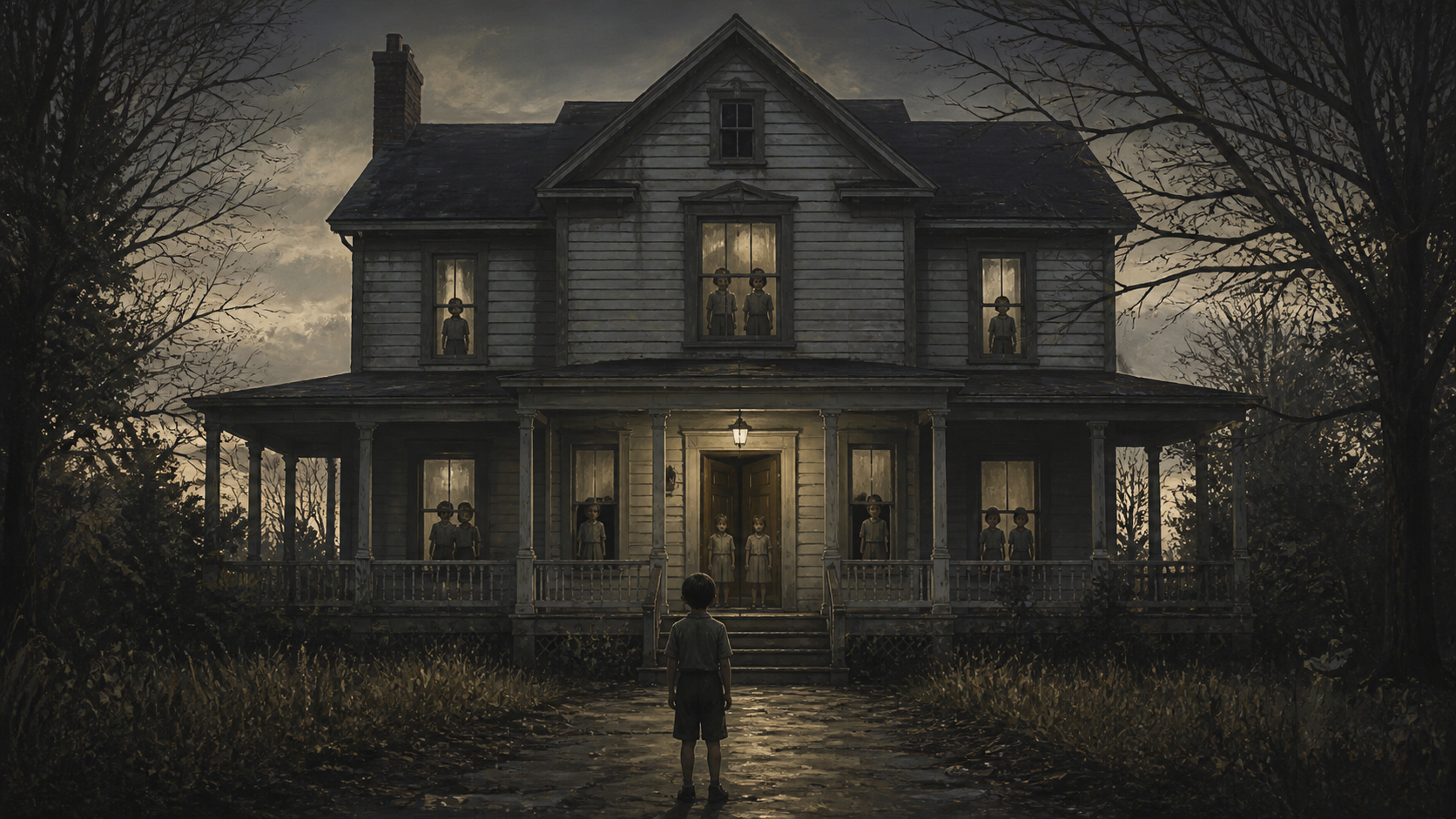
At the edge of the seafront they found the road partially blocked by temporary barriers and vans. The Neptune Hotel, a pale Victorian pile with bowed windows and a peeling sign, stood a little apart from the other buildings. A single light burned in the lobby. The rest of it looked shut, though from the outside the place was clearly open enough to be inhabited. Curtains drawn. Faint movement in the upper floors. An almost invisible haze of water on the glass.
Leonie parked a street away. “This is stupid.”
Tomás opened his door. “Yes.”
“Tom.”
He turned to her.
“Whatever this is, don’t do anything alone.”
He thought of the note. Do not come alone.
“I won’t.”
She hesitated, then reached into the glove box and handed him a small canister of pepper spray. “You can have this. Though I have no idea what it’s meant to do to a ghost.”
He took it. “Thanks.”
“It’s not a joke.”
“No.”
They crossed the road together, shoes splashing through shallow puddles, the wind pressing damply at their coats. The lobby door opened as Tomás reached for it.
No one had touched it.
Inside, the hotel smelled of polish, wet carpet and old heat.
The reception desk was empty.
A brass bell sat on the counter, and behind it a vase of chrysanthemums had gone brown at the petals. The desk lamp cast a yellow cone on a guest register open to a page half-filled in spidery script. Tomás saw his name already written there.
Not just his name.
His name, and Leonie’s.
The time beside them was 11:57 p.m.
Leonie stared at the book. “That’s impossible.”
From somewhere deeper in the hotel came the faint thud of a closing door.
A woman appeared at the end of the corridor as if she had stepped from shadow itself. She was in her sixties, perhaps, with a neat grey bob and a navy suit. Her expression was composed to the point of severity, but her hands trembled at her sides.
“Mr Vale,” she said. “You took your time.”
Tomás knew at once that she was not the one who had written the note, though she had the look of someone who had spent a long life tidying after disasters.
“You’re expecting me?” he asked.
“In a manner of speaking.” She looked at Leonie. “And you must be Ms Baptiste.”
Leonie’s jaw tightened. “Who are you?”
“Adele Mistry. Manager of the Neptune. Or what is left of it.” Her eyes moved to the key in Tomás’s hand. “You’ve brought it.”
“Whose key is it?”
Adele’s mouth tightened. “The room’s.”
Tomás looked up at the corridor. “What room?”
“Four seventeen.” She did not seem surprised that he already knew. “You should come upstairs before the others notice you.”
“The others?”
Adele glanced over her shoulder towards the dark corridor. “If you’ve got any sense, you will not ask that question here.”
She turned and began walking without waiting to see if they followed. Tomás looked at Leonie. She gave a short nod that meant neither of them wanted to do this, but they were in motion now whether they liked it or not.
They followed.
The lift was out of order. Adele led them up the back stairs, where the carpet was worn to threadbare red and the handrail felt cold and clammy under Tomás’s palm. Halfway up the second flight they heard footsteps below them, then another set above, as if someone were running down a corridor two floors away. The sounds moved in circles around them, never quite catching up.
Adele stopped at the fourth floor landing. Her face had gone an odd grey colour.
“Listen to me,” she said. “Once that door opens, you may see things you cannot trust. Not all of them will be dead. Not all of them will be alive. If you hear your own voice, do not answer it.”
Leonie folded her arms tightly across her chest. “You can’t just say that and leave it hanging.”
Adele gave her a tired, almost pitying glance. “I could, and I will, because there is no useful way to explain it in the time we have.”
Tomás looked at the number plaques on the doors.
At the end of the corridor, just beyond room 417, stood a tall figure in a bellboy’s uniform. He was so still that Tomás had first mistaken him for part of the décor. The boy, if he could be called that, had no face he could clearly see in the dim light. Only a smooth pale oval where the features should have been.
Leonie swore softly.
Adele said, “Don’t look at him for too long.”
The bellboy turned his blank head towards them.
A wet line of blood ran from beneath the collar of his jacket and down the front buttons.
Then he smiled, and the smile was wrong in a way Tomás could not have described if he had been asked. Too wide. Too patient. As if it had been waiting years to be used.
Adele produced a key from her pocket, inserted it into room 417’s lock and said, with great weariness, “Now.”
The door opened.
Tomás had been expecting a hotel room. Instead he stepped into a thick, clinging darkness that smelled of smoke and wet plaster and something sweetly burnt. The room appeared larger than the building could possibly contain. A double bed stood against one wall, its coverlet unmade. On the dressing table lay a radio from another century. The curtains were closed, though he could tell by the pale grain of light on their edges that dawn and sea existed outside somewhere.
Leonie came in behind him. Adele shut the door.
The room changed the instant it latched.
Not visually, exactly. More like a muscle twitching under skin. The air sharpened. A hum arose under the floorboards.
Tomás’s eyes were drawn to the bedside table.
There, under a lamp with a fringed shade, stood a framed photograph. He moved closer and realised with a lurch of nausea that it was of a young man in a suit and tie, smiling uncertainly at the camera. His hair was neatly combed. He stood in front of a station sign with luggage at his feet.
The sign behind him read, in crisp black letters: BRIGHTON.
At the bottom of the frame someone had written a name in ink.
Hideo Tanaka.
Tomás heard Leonie catch her breath.
Adele said, “He was supposed to travel.”
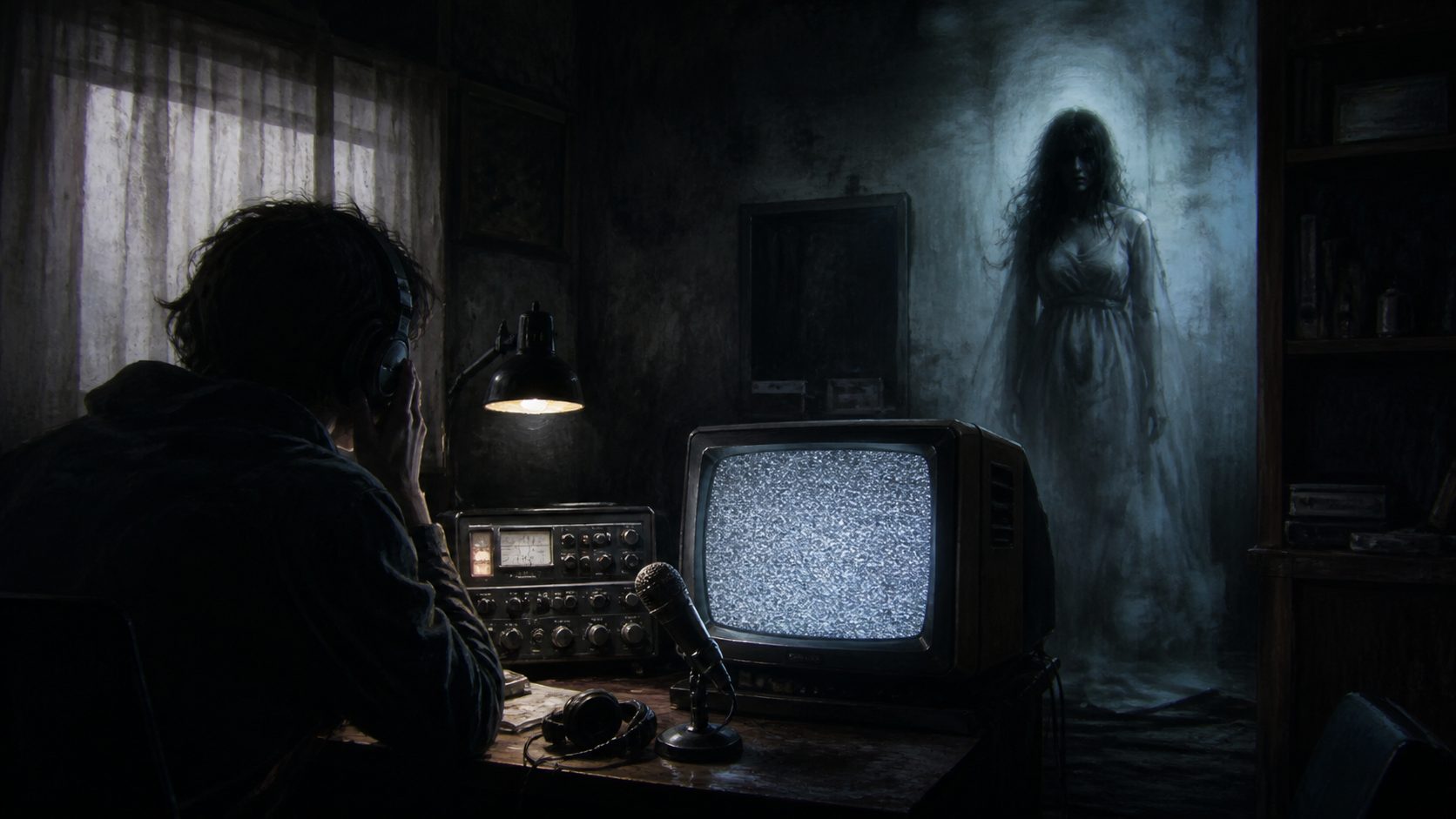
The radio on the dressing table gave a burst of static, then a voice. Japanese, though Tomás knew no Japanese. The voice sounded tinny, distant and desperate. It was followed by a burst of English, then more static. The set clicked, and the room filled with a low, rising whine like a kettle about to boil.
A shadow moved across the ceiling.
Tomás looked up.
For a moment there was nothing there. Then the ceiling seemed to peel open, not physically but in depth, revealing a grey sky above a city he could not name. The room was no longer in Brighton, or not entirely. He saw roofs, a bridge, a river reflecting a white sun, and the impossible calm of a summer morning.
Then the city flashed white.
Tomás flinched and threw up an arm. Leonie cried out. Adele swore sharply.
The light vanished.
When his vision cleared, the room was different again. Warmer, older, crowded. Suitcases lined the wall. A pair of polished shoes stood beneath the bed as if someone had just stepped out of them. The dressing table mirror was fogged with breath.
Something was standing in it.
Not behind Tomás. In the mirror itself.
A man in a travelling coat, one hand lifted as if about to knock on the glass from the other side. His face was real enough, but behind his eyes was an enormous distance, like a person looking down from the top of a deep well. He opened his mouth.
This time a voice came through the static, thin but audible.
“Please.”
Leonie’s hand found Tomás’s sleeve and gripped hard enough to hurt. “What does he want?”
The mirror-man looked at the key in Tomás’s hand.
Then he looked past Tomás, to the door.
The room door began to shake.
Not from outside. From both sides at once.
A sound like many people breathing in unison filled the space behind Tomás’s ears. The radio squealed. The mirror frosted over from the inside, and a woman’s face pressed into it, eyes closed, mouth open in a silent scream.
Adele stepped between them and the door. “Do not let it open on its own.”
Tomás turned, heart hammering.
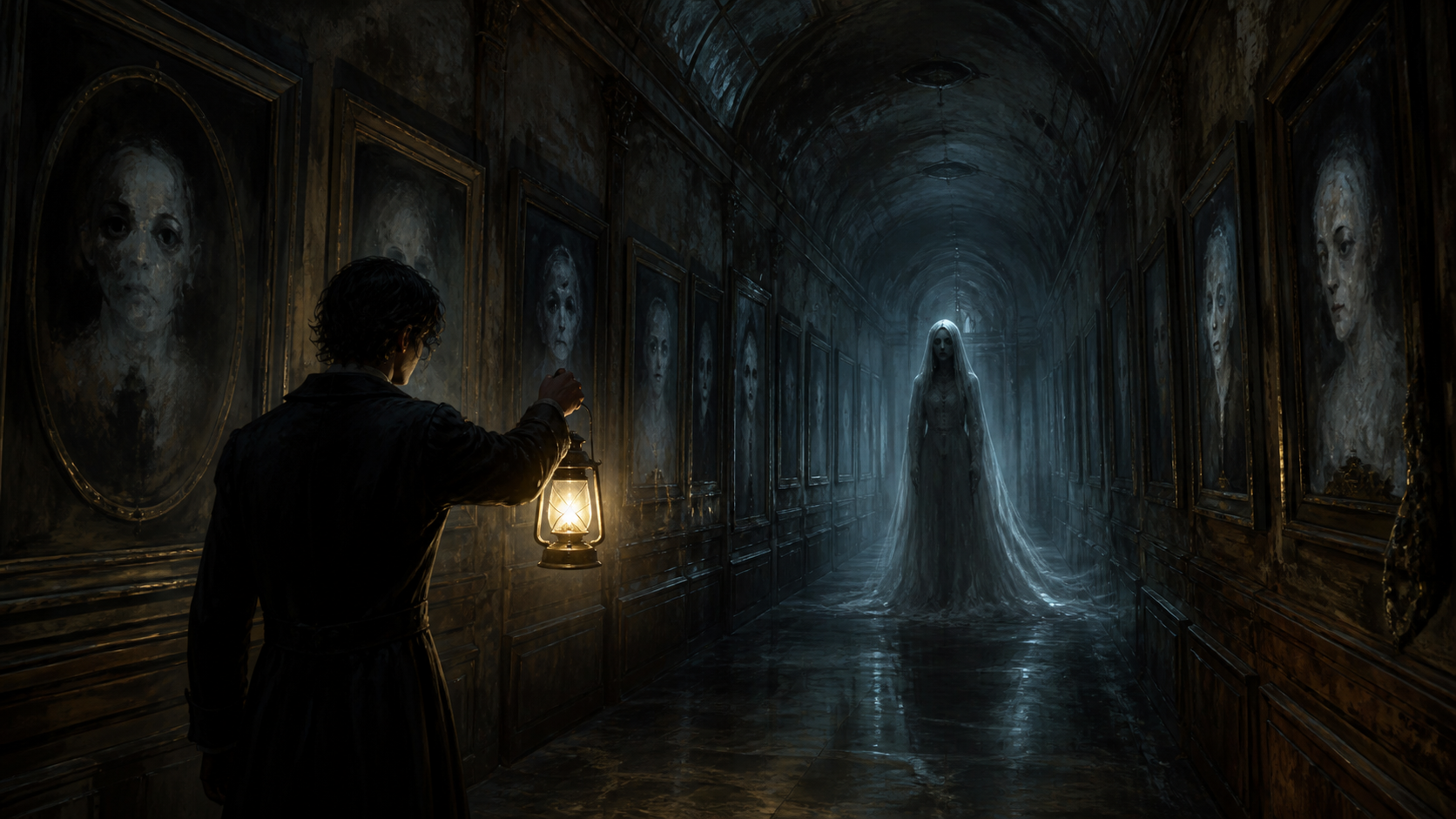
The hotel corridor had appeared in the mirror behind Adele, though it was not the same corridor they had entered from. It was longer, dimmer, lined with doors that did not quite stay still. Figures moved there, all of them half-seen, each one turning its face towards room 417 as if called.
The knocking at the room door changed into pounding.
Leonie backed away. “Tom.”
The glass in the mirror cracked from top to bottom.
A voice, now clearly English, whispered from somewhere in the room: “You came too late.”
Tomás spun, but no one was behind him.
Then something cold brushed his neck.
He looked down.
A hand, pale and waterlogged, had come through the gap beneath the bed and was reaching for his ankle.
He jumped back with a shout. The hand withdrew, and for one breathless moment there was only the darkness under the bed.
Then a face appeared there.
A child’s face, swollen and grey as if drowned, eyes open and fixed on him with terrible recognition.
Leonie made a sound of pure revulsion and stumbled into the dressing table. The photograph fell over. The radio burst into a shriek.
Adele was at the door, trying to keep it shut against whatever was pressing from the corridor. “If you have the key, use it!”
“On what?”
“On the thing that owns the room!”
That was the least helpful sentence Tomás had ever heard, but there was no time to argue. The pounding at the door had become a battering.
A crack split the wood near the handle. Through it seeped black water, or something that looked very much like black water.
Tomás backed away, key clenched in his fist.
The child under the bed was no longer alone. A second face appeared beside it, then another, layered like reflections in a pond. The room had become full of waiting mouths and pale wet eyes. The radio began to speak in a voice that sounded exactly like his mother’s.
He froze.
From the radio, in accented English, his mother said, “Tomás, open the door.”
His blood turned to ice.
Leonie shook him hard. “Do not listen.”
But the voice had reached some buried part of him with cruel precision. It sounded like the voice that had called him from the kitchen on winter evenings when he was nine. The voice that had died twelve years ago in a hospital room in Eastbourne with a church window above the bed and rain on the glass.
“Tomás,” it said again, softer. “It’s me. Open up.”
The pounding on the room door stopped.
Silence, broad and obscene, spread through the room.
Then the door handle began to turn slowly, though no one touched it.
Tomás knew, with a certainty deeper than thought, that if the door opened now the hotel corridor would not be waiting. Something else would. Something that would wear familiar voices as easily as clothing.
He looked at the photograph on the floor. Hideo Tanaka. The man in the mirror. The steam on the glass. The date that had changed.
And he understood at last that the key was not for entering room 417. It was for releasing what had been shut away in it.
But the thought came too late.
The lock clicked.
The room door swung inward.
There stood the bellboy from the corridor, face still blank, blood dry on his collar. Behind him, in the hall, were figures in suits and dresses and work clothes from other decades. Men with scorched skin. Women with wet hair plastered to their faces. A young girl with her hands tucked under her chin. Every one of them was staring into the room with the same attentive hunger.
The bellboy raised one hand.
Tomás felt the room behind him lurch, as if the floor had shifted under a ship.
Adele screamed, “No!”
But the thing in the doorway was already smiling wider than any human mouth should. Tomás snatched up the key, rushed to the mirror and drove it into the crack running through the glass.
The mirror burst.
Cold air screamed into the room. The radio exploded in static. The figures in the hallway all jerked at once as if yanked by a single cord. Something invisible and vast roared behind the walls. Tomás was thrown backwards. Leonie fell hard against the bed. Adele slammed into the doorframe.
The child under the bed shrieked.
Not a child’s cry, but a sound of many voices overlapped in a single narrow throat.
The room seemed to open. Not visibly, but profoundly, like the inside of a wound.
Through the broken mirror, Tomás saw a rail platform in brilliant light. Suitcases. Smoke. Heat shimmering over the concrete. A man in a white shirt turning with his mouth half open. Far beyond him, a city glared with impossible brightness.
Then the world shook.
The light went white and then far, far brighter than white.
Tomás threw an arm over his face. Even with his eyes clenched shut, he saw the blast bloom in his mind with appalling clarity: a sun falling into streets, shadows burned into stone, a pressure so immense it felt like a hand around the throat of the world.
Someone was screaming. Leonie, perhaps. Adele. Or all of them.
The heat hit next. Not the ordinary heat of a room or fire, but a dry searing force that stripped the air from his lungs. The room filled with the smell of burning cloth and hair and metal.
When he could see again, room 417 was no longer a hotel room.
It was a station platform under a sky gone sickly with light.
The bellboy stood inches away from him, now no longer blank but horribly expressive, his face split by a grin that belonged to no living thing. The corridor behind him had become an avenue of screaming shapes, some running, some collapsing, some simply standing in the brightness with their skin peeling away in sheets.
Leonie had one hand over her mouth and the other stretched towards him, but she was already fading at the edges, her outline trembling like heat haze. Adele was shouting something he could not hear.
Tomás realised with a horrible lurch that he was standing in the mouth of whatever had held this place closed. The key in his hand had done the wrong thing. Or the only thing it could do.
The bellboy reached for him.
His fingers were ice-cold.
Tomás hit him hard with the brass key ring, not because it made sense, but because his body had ceased to care about sense. The blow glanced off the side of the bellboy’s head. The figure recoiled with an outraged hiss, and in that instant Tomás saw the face beneath the face, all the way down. A mass of mouths and soot-black cavities, wet with old grief.
Leonie was shouting now, “Tom!”
He turned.
At the far end of the platform stood a woman in a summer dress, hair pinned back, face blistered by light. She was looking straight at him. Her expression was not accusation, not fear, but recognition so complete it struck harder than any scream.
Then the image shattered.
Tomás was back in the room, on his knees, gasping, with blood on his forearm from broken glass. The hotel corridor outside was full of motion and noise. Not footsteps. Running. Falling. Hitting walls. The doorframe itself had begun to sweat black water.
Adele grabbed his shoulder. “You must get out. Now.”
Leonie was at the broken mirror, staring through it at something that seemed to be moving deeper inside the shard. “Tom, there’s another one.”
He looked.
In the deepest broken piece of glass, small as a thumbnail, he saw a child seated on a suitcase on a platform, feet not quite reaching the ground. The child was watching him with dark, steady eyes.
Then the child lifted a hand and pointed behind him.
Tomás turned.
The dead were coming through the open doorway.
Not all at once. In fragments. First a hand on the handle, then a shoulder, then a face emerging from the dark corridor with a wet quietness that was worse than noise. Some wore hotel uniforms. Some wore travel clothes. Some were half-charred, some merely grey and exhausted, some smiling with their mouths open too far. They were not rushing. They were arriving.
Adele shoved him towards the hall. “Go!”
Leonie seized his arm and pulled, stumbling over broken glass. Tomás grabbed her hand and they ran.
Behind them, the room let out a long, keening cry that could have been a thousand voices or one. The corridor buckled. Hotel doors banged open and shut in furious succession. The lights went out in a chain down the hallway.
They reached the stairwell just as the first of the figures entered the corridor behind them.
Tomás looked once over his shoulder.
The bellboy had found its smile again. It stood in the doorway of room 417, one hand raised in a gesture that was almost courteous.
Then the skin on its face split, and a flood of light poured out.
Tomás and Leonie took the stairs two at a time, half falling, his injured arm slick with blood, her breath ragged and sharp. Below them the hotel bell began to ring over and over by itself, frantic and metallic, while from every floor above and below came the sounds of people waking up screaming.
They burst into the lobby.
It was crowded.
Not with living guests. With travellers from decades that should never have overlapped. Men in postwar suits, women in summer dresses, a nurse carrying a blanket, a boy in a school blazer with a burnt hole through his sleeve, a businessman in modern clothes with his face turned permanently towards the wall. All of them standing in a wavering, terrible silence, as if waiting for directions.
The receptionist’s desk had been overturned. Adele was nowhere to be seen.
The front door stood open onto the seafront road.
Beyond it, the night was full of people.
Tomás stopped dead.
Not people. Figures. Shapes moving in the fog, along the pavement, in the reflection of the rain-slick road. Some walked towards the hotel. Some stood facing the sea with their backs to the street. The whole seafront seemed to have filled with those who had missed their own ending and arrived here by mistake.
Leonie gripped his sleeve. “Tomás.”
One of the figures outside turned its head.
It was his mother.
Or something wearing her face.
The sight hit him with such force that his knees nearly gave way. She looked older than he remembered and younger too, all at once. Her eyes were fixed on him with a sorrow so vast it seemed to contain weather. Her mouth moved.
Not in the way the radio voice had done. This was worse. This was intimate.
Tomás heard her, though the surf and the wind had risen and the hotel was howling behind him.
“You didn’t come when I called.”
He could not breathe.
Leonie tightened her grip and shook him once, hard. “Tom, move.”
The front doors slammed shut of their own accord.
The lobby lights flickered red.
And from somewhere upstairs, in the darkened skeleton of the Neptune, the bellboy began to laugh.