Mongolian Death Worm
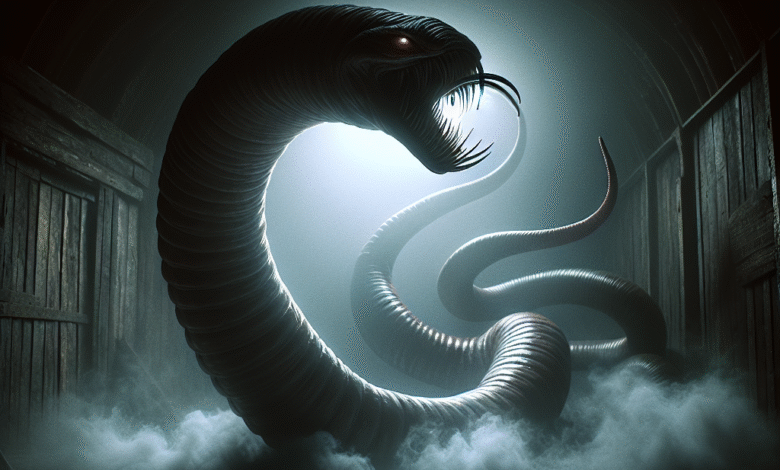
The Terrifying Tale of the Mongolian Death Worm: A Journey into the Unknown
Deep within the arid expanse of Mongolia, where the Gobi Desert stretches endlessly under a sun that seems to scorch the very earth, there exists a creature wrapped in mystery and dread—the Mongolian Death Worm. Known locally as “olgoi khorkhoi,” which translates to “large intestine worm,” this ancient entity is a chilling part of Mongolian folklore, captivating adventurers, scientists, and cryptozoologists alike with its nightmarish tales.
Origins and Cultural Background
Mongolian culture holds a rich tapestry of oral tradition, where stories of the extraordinary are woven into the very fabric of life in the harsh desert. The olgoi khorkhoi has been part of this tradition for centuries, supposedly inhabiting the untraversed sands of the Gobi. Descriptions of the creature vary but generally depict it as a massive, serpentine worm measuring up to five feet in length. Its color ranges from a grotesque brown to a deep, blood-red—colors that echo the innate brutality of the world from which it hails.
Local legends suggest that the worm’s deadly reputation comes not only from its enormous size but also from its lethal capabilities. It is said to possess the ability to emit a venomous electrocution that can kill a man at a distance or unleash a dreadful acid that burns through flesh. These legend-born attributes have encouraged both reverence and fear among the nomadic tribes who traverse the region. To these people, the olgoi khorkhoi is not merely a beast of nightmare; it is a spiritual guardian that protects the sacred expanses of the desert.
Sightings and Legends
Reports of the Mongolian Death Worm date back to at least the 19th century, when explorers began traversing the Gobi. One of the most prominent accounts comes from a 1920s expedition led by the famed explorer, Roy Chapman Andrews. His team, while searching for dinosaur fossils, gathered tales from local Mongolians who recounted startling encounters with the beast. Some claimed to have witnessed the creature erupting from the earth, while others talked of its ferocious strikes against animals and unwitting travelers.
Modern sightings have become somewhat of a phenomenon among cryptozoologists and thrill-seekers. Enthusiasts armed with cameras and a profound hunger for discovery have tried to track down the olgoi khorkhoi, often documenting their experiences through various mediums. The most recent flurry of sightings was reported in the early 2000s when several tourists and locals claimed to have caught glimpses of the creature burrowing in the sand or launching into the air.
Yet, despite rigorous investigations, scientific expeditions have failed to produce concrete evidence of the worm’s existence. This elusiveness has only deepened its allure, cementing its status as one of the world’s most enigmatic monsters.
Appearances in Popular Culture
The allure of the Mongolian Death Worm has seeped into popular culture, leaving an indelible mark in literature, film, and even video games. Author and screenwriter, Nigel Kneale, brought the olgoi khorkhoi to the screen in the 1970 horror film “The Creature,” though more recent interpretations lean towards the speculative and sensationalist. The notorious Syfy channel produced the film “Mongolian Death Worm” in 2010, a campy horror flick where the worm terrorizes everyone in its path.
In literature, it appears in the grim backdrop of fantasy novels and horror anthologies alike, serving as a fearsome creature that challenges the courage of protagonists. Its fusion of the mundane with the supernatural embodies mankind’s age-old struggle with the mysteries of the natural world.
Not limited to traditional storytelling, the olgoi khorkhoi has also spurred the imaginations of game developers. Tabletop role-playing games have included this fearsome creature in their monster manuals, while video games drafted its legend into narratives where players confront it in fantastical landscapes.
A Creepy Fun Fact
Despite its frightening reputation, anecdotal evidence regarding the olgoi khorkhoi is intriguingly varied. Some stories assert that the creature is linked to a more ominous urban legend—that the desert harbors not just the olgoi khorkhoi, but other mysterious entities, including spirits of fallen warriors. Travelers who venture too far into the desert may inadvertently provoke these spirits, leading to a perilous encounter with the Death Worm itself.
Sixty years after encountering the creature, one erstwhile traveler claimed that the sands of the Gobi shift, revealing itself not just as a physical realm but as a spiritual labyrinth where the ancient and the supernatural intertwine.
In conclusion, the Mongolian Death Worm is more than just a cryptid; it is emblematic of humanity’s deepest fears and respects within the vast wilderness. The legend continues to unfurl like the desert sands, capturing our collective imagination and reminding us that the world still holds dark, untamed mysteries waiting to be uncovered—or perhaps better left buried.