Gashadokuro
The Terrifying Tale of Gashadokuro: Japan’s Giant Skeleton
In the darkened corners of Japanese folklore, where shadows entwine with the whispers of the past, lies the legend of Gashadokuro—a towering skeleton born from the restless spirits of the nameless and forgotten. Cloaked in mystery and dread, this supernatural entity serves as a testament to the haunting consequences of war and the heavy toll of death unassuaged. But what exactly is Gashadokuro, and why does this monstrous specter evoke such fear?
Origins and Cultural Significance
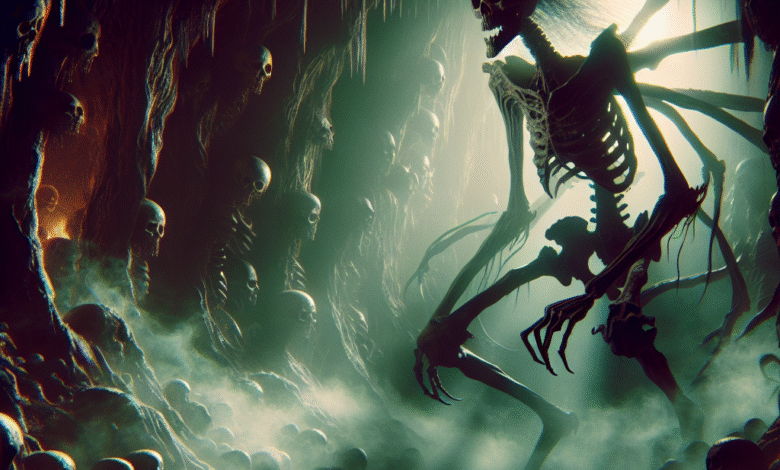
Gashadokuro translates to “starving skeleton” in Japanese, and it is said to emerge from the remains of people who have suffered untimely or tragic deaths—specifically, those who perished in battle or from starvation. These lost souls become restless, their anguish and suffering giving birth to the Gashadokuro: a colossal being that stands over fifteen feet tall, crafted from the bones of the dead and held together by malice and sorrow.
The origins of Gashadokuro can be traced back to the Sengoku period (1467-1603), a time characterized by social upheaval and relentless warfare. The countless souls lost during battle left behind a legacy of grief, allowing the legend of the Gashadokuro to grow. It is said that a Gashadokuro is only born after ten thousand people have died—depicting the vast number of lives claimed during this tumultuous era.
In Japanese culture, the entity embodies the concept of retribution for the unacknowledged dead. It serves as a powerful reminder of the consequences of war, urging the living to honor the memories of those who have been neglected and forgotten. The Gashadokuro stands as a guardian, ensuring that these spirits find their peace, albeit through terrifying means.
Legends and Sightings
The legends surrounding Gashadokuro are as chilling as the creature itself. Folklore tells that it roams the night, its hollow bones clanking ominously in the darkness. Victims often describe a faint sound of rattling bones, which serves as a premonition of the beast’s approach. Victims of this ghastly apparition face a grim fate: it is said that Gashadokuro can crush its prey in a single grasp or, even worse, consume them whole.
One popular tale recounts the encounter of a weary traveler who, lost in the mountains, stumbled upon the towering skeleton. The Gashadokuro loomed over him, and as its chilling gaze pierced through the gloom, the traveler managed to escape only by recalling the names of the dead, thereby acknowledging their existence. This demonstrates a core theme in the Gashadokuro legend: only through remembering and respecting the dead can one hope to escape its wrath.
Gashadokuro in Popular Culture
The influence of Gashadokuro extends beyond the realm of folklore and into the corridors of modern popular culture. Its iconic imagery has stirred the imagination of creators, artists, and filmmakers alike.
In the realm of animation, Gashadokuro makes a haunting appearance in the critically acclaimed anime series Naruto, where a character is cursed by the spirit of Gashadokuro. With its menacing presence and chilling aura, it amplifies the themes of vengeance and the weight of death.
In the world of gaming, Gashadokuro takes on a formidable role in titles such as Nioh, where players encounter this terrifying entity as both a challenge and an embodiment of folklore. Its appearance brings to life the vivid imagery of bone and darkness, striking fear into the hearts of gamers as they engage in battles against this insatiable beast.
Literature too has found inspiration in Gashadokuro, with tales featuring the creature becoming an integral part of anthologies that explore the uncanny and the supernatural. Stories often emphasize its tragic origins, blending horror with human emotion, creating a narrative that resonates deeply with readers familiar with loss and forgetfulness.
A Creepy Fun Fact
As the legend of Gashadokuro continues to evolve, it gives rise to chilling urban myths. One particularly eerie tale suggests that on moonless nights, if you find yourself in a battlefield or site of ancient conflict, you may hear the distant sound of clanking bones—a warning that a Gashadokuro might be lurking nearby, hungry for the souls of those who cannot be at peace. Be wary, for it is said that if you hear the rattling, it is not just an omen but a summons; the Gashadokuro beckons the unwary to heed the lives lost and be vigilant against the grip of oblivion.
In a world where horrors lurk just beyond the veil of reality, Gashadokuro stands as a powerful reminder of the weighty consequences of neglecting history, urging us to honor the dead so that the living may remain free from their grasp. When you hear a rattling sound in the shadows, perhaps take heed—it might just be the echo of a hungry Gashadokuro searching for its next victim.