Manticore
The Manticore: King of the Beasts and Nightmares
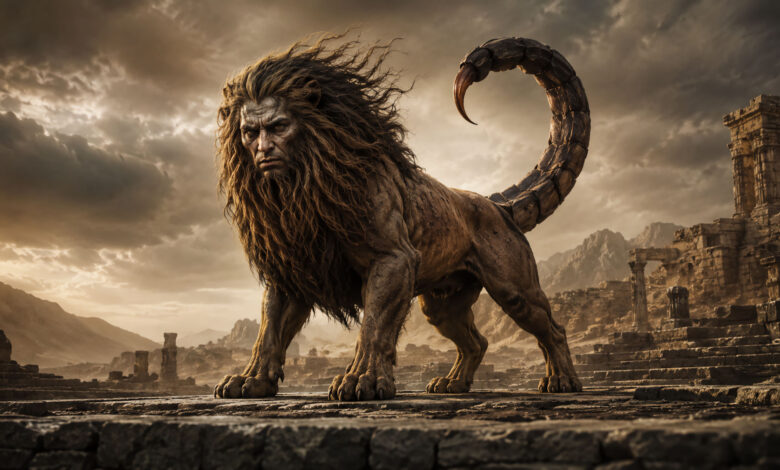
In the shadowy corners of mythology and folklore, where fear mingles with fascination, the Manticore reigns supreme—a creature woven from the fabric of nightmares and the wild imagination of ancient civilizations. Picture, if you will, a being that combines the ferocity of a lion, the wings of a dragon, and a tail armed with deadly, scorpion-like stingers. With roots buried deep in Persian and Greco-Roman lore, the Manticore’s legend has evolved, taking on new forms throughout history, becoming a fearsome figure that inspires both awe and terror.
Origin and Historical Background
The Manticore originates from the ancient texts of Persia, where its name translates to “man-eater.” Its first recordings can be traced back to the 3rd century BCE, where it was described by the Greek philosopher Ctesias. In his work, “Indica,” Ctesias depicts a creature that possesses the body of a lion, a human head with sharp teeth, and a tail laden with barbed stingers—each possessing the capability to shoot venomous darts at its prey, much like a scorpion. This grotesque amalgamation embodies humanity’s fear of the unknown and the savage nature of unchecked power.
The Manticore was not merely a solitary creation; instead, it reflected the cultural anxieties of the time. As ancient societies expanded their horizons—trading and engaging with other cultures—the creatures of myth morphed as well. Tales of one-eyed giants, fire-breathing dragons, and fearsome beasts like the Manticore illustrated the clash between civilization and nature. It served as a reminder of humanity’s vulnerability in a world filled with uncanny wonders and lurking horrors.
Sightings and Legends
The legends surrounding the Manticore are as varied as the cultures that have embraced it. In ancient accounts, these creatures were said to inhabit remote, unforgiving landscapes, where their predatory instincts thrived. Word spread of encounters with Manticores that left a trail of devastation—disappearing villagers, drained of their very life force, and livestock that vanished overnight.
Medieval bestiaries also captured the Manticore’s essence, where it was often associated with moral lessons. In the 12th century, a famous bestiary attributed various traits to the Manticore, illustrating it as a symbol of tyranny and deceit. Tales circulated of Manticores lurking near kingdoms, feeding on the souls of tyrants and corruption, rendering them foes not just of physical manifestation but of moral failure as well.
Moreover, many sightings seemed to allude to the darker aspects of human nature—twisted reflections of war, ambition, and evil lurking just beneath the surface of civility. Its imagery persisted for centuries, ingrained into the psyche of various cultures, unearthing fears that continue to haunt humanity long after the tales have been told.
Appearances in Popular Culture
As centuries rolled into modernity, the Manticore adapted, casting its shadow across contemporary culture. The beast appeared as an imposing entity in literature, most notably in the fantasy genre. It prowls the pages of such seminal works as The Chronicles of Amber by Roger Zelazny and The Witcher series by Andrzej Sapkowski, where it embodies the fantastical threats of its universe.
Video games, too, have paid homage to this formidable creature. In titles such as Dungeons & Dragons and Dark Souls, players engage in perilous battles against Manticores, demonizing their desperate lunge to conquer powerful foes and recapture lost treasure. The Manticore is often depicted with its signature lion’s body, but the complexity of its design has evolved, allowing for creative interpretations that highlight the bestial horror of the beast.
The creature’s influence isn’t limited to fantasy alone. Movies like Clash of the Titans have showcased Manticores not only as terrifying foes but also as symbols of mankind’s age-old struggle against monstrosities—be they mythic creatures or the unpredictable beasts that dwell within the human heart.
A Creepy Fun Fact
In classical interpretations, the legend of the Manticore was so frightening that it bled into the real-world fears of various societies. It’s said that the fear inspired by the Manticore led some rulers to practice extreme forms of caution and paranoia in their reigns. An urban legend emerged that local witches could summon a Manticore to punish those guilty of betrayal. Superstitious communities held rituals to ward off the monster, believing that its stingers could corrupt not only physical forms but sow discord among communities—turning friends against each other.
So, the next time you hear the wind howl or feel the subtle chill brush against your spine, think of the Manticore—a reminder of the shadows lurking in folklore that continue to haunt our modern sensibilities. In a world filled with myths that refuse to die, the Manticore remains a king of beasts, eternally tethered to the depths of our imagination, a spectral reminder that dread, like a good story, never truly fades away.